Sunday, May 31, 2009
How To Rebuild Snowmobile Crankshaft
The Baroque is the term commonly used to indicate the literary culture, philosophy, art and music characteristic of the period from the end of the sixteenth century to the middle of the eighteenth century. By extension, then it indicates the name "baroque" style linked to the artistic events of this period.
The term derives from an ancient word Portuguese barroco (barueco in English), used to define a Baroque pearls or a pearl is not cultivated, non-symmetrical. Precisely because of the peculiarities of his style of baroque art approaches the Baroque pearls.
The Council of Trent, which ended in 1563, had marked a milestone in Catholic culture, dictating the rules accurate even for the arts. The aim of painting and sculpture in the churches had to be to also explain to the illiterate episodes of the Bible and the Christian tradition. This drift towards a populist conception of art in religious buildings is regarded by historians as one of the major elements of the innovations of Caravaggio and the Carracci brothers, who worked in Rome in 1600, playing the various work orders.
The charm of the baroque style was derived in a way fully aware of the agility and intellectual qualities of the sixteenth century Mannerist art, extended up to a visceral appeal that pointed to the involvement of the senses. Iconography was used as much as possible direct, simple, obvious, but still play. Baroque art began to emerge on certain trends and the essential heroism of Annibale Carracci and his circle, finding more inspiration in other artists like Correggio and Caravaggio and Federico Barocci, who is referred to as proto-baroque. The embryonic ideas of the Baroque can also be found in Michelangelo Buonarroti. A sort of parallel is possible with the music business, so as to make meaningful and useful the term "baroque music": There are conflicting phrases in length and harmony, counterpoint is taking root replacing polyphony, tone and orchestral amalgam makes its appearance with increasing insistence. Are still many more parallels General advised by some experts in philosophy, literature and poetry, much more difficult to pinpoint.
Although the Baroque, in many centers, is replaced by the Rococo, which takes its moves in France at the end of 1720, particularly as regards the interior, paintings and decorative arts, Baroque architecture is a style present and fully in use until the advent of Neoclassicism in the late eighteenth century. See, for example, the Royal Palace, the Baroque palace (though the exterior is somewhat sober) that is not started if not in 1752. Critics, in fact, no longer speak of a "baroque."
In painting, the forms of the Baroque are broader than Mannerist: less ambiguous, less arcane and mysterious, closer to that work, one of the main forms of Baroque art. The installation depends on the baroque opposed ("opposition"), with the tension that the characters move with the shoulders and hips which are plans that move in opposite directions. See Bernini's David.
scenes drier, less dramatic and less coloring, generally more temperate architecture of the eighteenth century are often framed as separate events late baroque (see Claude Perrault). The phenomenon known as neo-Palladian, played by William Kent is a parallel development that takes place in England and the British colonies. The baroque is
Wolfflin defined by Heinrich (1888) as the period in which the oval gives way to the circle in the center of the compositions, such centralization replaces the balance and from that moment the most vivid and pictorial effects begin to become more apparent.
Some historians, mostly Protestant, have emphasized that the Baroque style occurred in a period when the Roman Catholic Church had to react to the many revolutionary cultural movements that produced new science and new forms of religion, Protestantism. It has been said that the baroque, so monumental, it is the style that could give the papacy, as an absolute monarchy, a way of imposing and formal expression to restore its prestige, to the point of becoming somehow a symbol of the Counter Reformation.
no coincidence that the greatest development occurs in that of Rome, where the Baroque architecture widely renewed the central area of \u200b\u200burban planning with a review which is probably one of the most important.
Saturday, May 30, 2009
Snowmobile Best Looking Helmet
Since the early seventeenth century, we realize that there are periods in the social life in which difficulties arise in the structures and the conduct of collective life that hinder your progress. E 'is known that during the seventeenth century the English monarchy clashed with financial difficulties and was facing serious economic problems that stemmed from the growth daily prices. As might be dark but we can not idealize the situation of earlier times, probably the Andalusian peasant, the weaver Segovia, workers burgalesi markets, have not found much better at other times. From the moment you see the man we call modern man, with his achievements on the nature and new ideas about society, begins to develop in him the ability to understand that the problems of the economy and other aspects of social life not go so well, and that could be better. The word "crisis" appears much earlier in the field of medicine, and the adjective 'critical' is beginning to be used in the early seventeenth century. It 's a term that, when we investigated relentlessly critical of the phenomena that is experienced, he writes copiously about them, that is the way to restore the affairs of the monarchy. Between the fifteenth and seventeenth century coincided with the period in which conditions are beginning to show the first type of pre-capitalist, arose the first type of cyclical economic crises which, at first, were seen a bit 'confused, but they were included as such, which allowed him to see that by manipulating the factors that caused the reversal of the situation, the most evident effects of the crisis disappeared. Therefore, if there is an improvement, it meant that he had managed to overcome the crisis, and that the "remedies" put in place in humans had somehow worked favorably. In the sixteenth century occur in some cases reversed with very favorable results to the end of the century, and this increases confidence in the reform of the human capacity, so that the praise, according to the old topos of dignitas hominis, will change shape , leading to the highest esteem for constructive man, able to correct and to create a new reality or economic nature.
Human intervention may help to improve a situation but may also worsen. The inadequate measures proposed by the government may also hinder the process of restoration a crisis, may indeed even provoke it. An anonymous written addressed to Philip IV around 1621 reflects this state of mind in all its aspects: "The negligence of those who govern is, without doubt, the cause of misfortune, and passage from which come all the ills and failures of a nation, and no, I think, is affected as much as ours, who live without any fear or suspicion of a ruin next, relying on a misplaced presumption. " The economic crisis does not cover all of the seventeenth century, but the social crisis and it extends beyond the limits. We speak of social crisis with regard to aspects that can be proven:
1) order of society in the seventeenth century there is alteration of the values \u200b\u200band the corresponding models.
2) whether any particular society requires the active or resigned acceptance of such values \u200b\u200band behaviors, their questioning carries with it varying degrees of alterations in the integration of individuals whom it is performed unequally.
3) in relation to the attempt to classify individuals and groups, fostering in them a feeling of oppression and anxiety, produce obvious effects of illness and more or less open opposition.
4) will produce changes in the relationships and constraints that bound individuals to each other, even more changes that seemed heavy to those who suffered.
5) appear critical background and denounce the malaise has raised, more or less frequently, some cases of deviant behavior and tensions between groups, which, if they reach a certain level of condensation, they explode in riots and sedition.
crisis occurs in all European countries, from Spain to France, from Germany to Italy, while in England until the crisis is still not prevail under the Revolution, the factors that were changing the structure of the country. Moreover, this crisis is common to all European countries during the century should not be considered as a new phenomenon resulting from the Thirty Years' War, as the crisis began much earlier, an interest bearing not involved in the war and was even more severe in countries that do not directly suffered the effects of the destruction and troops, and was not overcome by the restoration of peace.
The absolute monarchy to solve the social crisis
to restore a situation of civil peace you create a wide-ranging social forces tending to contain the dispersion that threaten to disrupt the traditional order. To this end, it has the hands of the powerful tool of absolute monarchy, probably already used to stop any movement in the Renaissance development, and that in the new circumstances of the crisis of the seventeenth century will be applied to defeat the various factors that attempt to overthrow the established order. Absolute monarchy becomes the keystone of the social system, we are in front of the absolutist regime of the Baroque, where the monarchy represents the apex of a set of interests noble restored, which is based on the supremacy of land ownership, which in turn is the basic system. None of this could simply mean a return to a feudal society dominated the aristocracy, as the nobles were in many respects equivalent to the rich landowners. Although the level of the nobility, it gave an indisputable superiority of the monarchy in hours increased by the central presence of other social strata. They had classes from which could spring the threat of destabilization, to avoid what could be just try to exercise control over them, and integrates in some way to the maintenance of large segments, involving them in his own defense, encouraging them to increase their tax effort: in short, by integrating these classes to the greatest extent possible, in a system that we have to consider like new. It is therefore the pyramid-feudal monarchy based proto-national companies which we call the Baroque.
The aristocracy in the seventeenth century
Although there are some values \u200b\u200bof the culture of chivalry, it is precisely the kind of society that promotes the Baroque culture. How monarchical absolutism can not be confused with the arbitrary system of capital feudal kingdom, so the culture of chivalry and Baroque culture can not overlap. The basic principle of a company ends up also dominate the economic activities. In France the nobility with his habits luxuries subtracts from the potential productive investments a significant proportion of revenue, worsening an economic crisis, and there will then require a reservation of seats of honor in public administration and calls for timely maintenance of the external signs - such as the dress - which distinguish individuals of different social strata. Therefore seeking to increase their territorial domains, and instead to devote to the exercise of manufacture or trade, confirms the concept prohibiting the compatibility of such activities with the privileges of nobility, if a law allows in the seventeenth century that the two are compatible, however, were few to enter the system, in some cases using an intermediary. In Spain, these facts are presented with more pronounced rigor.
Change
If all the values \u200b\u200bof the Baroque period was a time of "reaction of the nobility ', the phenomenon is accentuated in recent decades. Here is the reason and the sense of the system privilege with all sorts of benefits the notables in order to maintain order. It is believed that the decline and loss of power of the bourgeoisie during the first half of the seventeenth century are due to a strengthening of the calculated power the nobility, who, in order to find support, carrying with it's enriched so as to stop the other teams on the rise. Around 1620, "the independent merchant, who represented a prototype of the easy life, almost disappeared in Western Europe, from its ranks because few have gone out and climbed up, making the children, if they could not themselves, officials gentlemen, but the rest, who are the most, going to prisons and while taking note of their declared insolvency of their failure, have become the poor. In the seventeenth century the nobility recovers an important role, based on economic and social, in the reorganization of the absolutist monarchy. The monarchy has no doubt increased his political power, but we must keep in mind the compromise agreement with the nobility. There are several examples in which they persecute and punish the rebellious noble, but only in cases where it failed the requirement contract, which is collaboration and distribution of power between the king and the nobles, on which the regime in the seventeenth century. Not prosecuted nor in any way destroys the noble as such: on the contrary, he is always considered as the bone of the nation. Its privileges, except those purely political, remain in first place, the rights are those of elegant face to the farmers and preserves its full tax immunity. Absolutism not abolished the old hierarchical social order, modified, it is true, the relationship between the different classes and the king, but left unchanged the mutual relationship.
The Church introduces its code of morals "Christian" modes of behavior, interests celebrated aristocrats: ways that probably formed under the framework of the Christian Church of Rome throughout its history. Codest ideals in Spain Count-Duke is no different from those of the France of Richelieu: the other animated by a contempt for the bourgeoisie, which resisted all change, and a deep-seated revulsion against the populace.
's repertoire means that you need the baroque monarchy to be able to impose itself upon tension of opposing forces is very wide. From the physical repression, based on military strength, political supremacy of last resort, to the psychological mechanisms that affect consciousness and produce a repressed desire. Between these two extremes there are many different means, the use of which is surprising and perhaps only be explained with psychological and moral assumptions of the Baroque. When it occurred at Madrid some sacrilegious acts in different periods and even, in one case, two in one day and in different churches, repressive and punitive measures were taken to consist in eliminating the eight-day comedies and impose abstinence sexual.
Friday, May 29, 2009
Refinishing A Table With A Painted Surface
addition to the Baroque, the great event featuring the civilization from the seventeenth century represented a profound movement of renewal in the field of scientific culture that runs through the whole of Europe. Such a radical transformation of the method was so great and the discoveries that result from this experience was described as "scientific revolution", judging rightly one of the milestones in human history. In fact, if we consider together the rhythms of the historical evolution, we see how science and technology for millennia have remained essentially property: from antiquity to the Renaissance, except for some important but isolated discoveries or inventions (gunpowder, the compass, printing), life had continued to unfold in the same way, with the same energy sources, the same means of transport, the same production techniques. The parable of this great cultural revolution extends for about a century and a half, from 1543, the year of publication of Copernicus' De revolutionibus orbium coelestium in 1687, what is given to print the book by Isaac Newton (1642-1727) Philosophiae naturalis Principia Mathematica. The decisive moment of this process occurs around twenty years 1620-1640: to date, in fact, even in Italy the conditions are a direct participation in the most advanced European culture, as well as beyond that period started a being clear exclusion from the intellectual context. The interest generated by Galileo Galilei around the study of natural phenomena, a concern which he led through its discoveries and its intellectual affair (the controversy, the processes, the final abjuration), affecting all fields of knowledge: in this context has altered the role and function of the scientist that the same "image of science." Although the new science is linked to, previous experience (first, humanism and naturalism of the Four-sixteenth century), the basis of this revolution is a completely original factor that constituted the essential driving force: the experimental method . In fact, while in the ancient world and throughout the Middle Ages the mechanisms of knowledge were based on the "principle of authority", which placed the interpretation given by the great thinkers of the world (primarily from Aristotle) \u200b\u200band Sacred Scripture as unquestionable truth, in the seventeenth century began to assert a new way to analyze reality, in which observation and experience replace the uncritical acceptance of authority "means the natural philosopher no longer passively accept what is suggested by his predecessors, but he wants to prove the validity of their results, and, if necessary, modify, correct or alternative hypotheses and therefore does not recognize any relationship other than that of experimental verification. This produced some new logic consequences: first, to question, subjecting them to try the experiment, the truths expressed by the two largest sources of authority: political power and religious power, the second of the freedom of science and scientists from all forms of external influences. Both these positions were immediately perceived as extremely dangerous for power, and then persecuted with great decision by the repressive structures that had come through the consolidation of absolutism and the Counter. The struggle for the conquest of scientific freedom becomes the freedom struggle in toto, so that its characters cross the boundaries of the history of science and to fit among the builders of modern civilization understood as a whole. The phenomenon of the scientific revolution was the international dimension and leading figures from across Europe: the Polish Nicolaus Copernicus (1473-1543) - cosmologist that the heliocentric theory was the precursor of the new era - the Danish astronomer Tycho Brahe (1546-1601) and the German Johannes Kepler (1571-1630) - who developed the insights - English Isaac Newton (1642-1727) - with which physics, astronomy and cosmology are merged into a general system for many aspects still valid today. In the field of mathematical studies, contributions must be of exceptional importance to the French RenĂ² Descartes (Descartes, 1596-1650) and Blaise Pascal (1623-1662), and Germany's Gottfried Wilhelm von Leibniz (1646-1716). A decisive enrichment of knowledge derived from physiological and anatomical studies of Andreas Vesalius Flemish (1514-1564) and Italian Marcello Malpighi (1627-1694). But as far as Italy is concerned, there is no doubt that the most important figure is that of Galileo Galilei (1564-1642), astronomer, physicist, mathematician, philosopher and prose writer for the great elegance of style and mastery of language.
What Colour Is The Acute Hiv Rash
"Baroque and the terminal used by art historians to describe the dominant style in the period 1600 to 1750. Its original meaning of "irregular, twisted, grotesque and bizarre," has now been extensively revised. The Baroque style was founded in the late sixteenth century, but was born in Rome around the third decade of the seventeenth century. "
Baroque Painting
Extremely varied and complex appears to us the painting of the Baroque period, the Counter-Reformation church became the main buyer for the paintings. Focusing on the persuasive power of beauty The church found in the art the right way to bring the world to the Christian faith as it was able to influence the emotions.
In this period, therefore, intensify the representations of sacred scenes are painted especially those persons who had challenged the thought reform, for example the cult of Mary.
The Palaces and especially the churches were decorated with huge and magnificent frescoes that were close to reality thanks to the absolutely natural representation of the characters. This gives the sacred scenes represent a character that brings credibility to the faithful.
Great importance was given to the decoration of the ceilings, the Baroque painters, thanks to the mastery of perspective could broaden the opportunities for creating architectural spaces unreal uniting heaven and earth, for example the ceiling of the church of St. Ignatius to Rome painted by Andrea Pozzo in which real figures sway suspended in the air between heaven and earth, creating an effective trompe l'oeil.
There were two art movements that were developing in the seventeenth century: the naturalistic with the classic one proposed by Caravaggio and the Carracci school.
Caravaggio introduced in his paintings the reality of every day, even when he painted religious subjects, he sought the truth, representing the figures of Christ, the Virgin Mary, the apostles, using as a model for ordinary people, such as those that could meet at that time the streets, making them emerge from a particular light. This painting
naturalist spread rapidly in Italy in the first twenty years of the seventeenth century, the most important representatives include artists such as Orazio Gentileschi and his daughter Artemisia, Bartolomeo Manfredi and Battistello Caracciolo, as well as many foreigners who worked in Italy, including the French painter Valentin de Boulogne and English Jusepe de Ribera.
The school that developed around the Carracci instead seeks to return to the principles of clarity, monumentality, and balance typical of the Renaissance.
Of the three Carracci, Ludovico, Agostino and Annibale was the latter to be more successful. This style was adopted by classical artists such as Guido Reni and Domenichino.
Baroque architecture
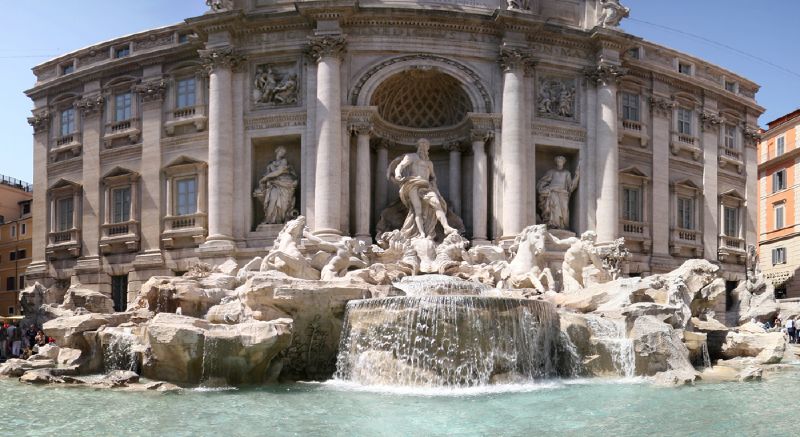
Baroque architecture expressed in the monumental forms. Many cities in this period take on a different aspect: creating new roads tearing down the old medieval quarters. The palaces, the squares are constructed with a strong dramatic intent, aiming to arouse the viewer wonder and admiration.
The buildings of the nobles are divided into several sections around a garden adorned with fountains, statues, paths and waterfalls that were designed with their spectacular to celebrate itself the ruling class. As for the churches, we prefer the plant or central nave with majestic domes and roofs. The facade is covered with sculptures has a feature highly scenic.
Among the major architects of the Baroque period there was Carlo Maderno, who built the extension the nave of St. Peter's and completed the facade that had been begun by Donato Bramante. More important was
architect Borromini, among his accomplishments, a splendid example of Italian baroque, include the facade of San Carlo alle Quattro Fontane in Rome, with its concave and convex taken inside the church.
was active in Venice Baldassarre Longhena realizes that the church of Santa Maria della Salute, Guarino Guarini in Turin built the Chapel of the Holy Shroud.
in Naples between the most emblematic buildings include the cloister of the Certosa di San Martino, the spire of San Gennaro and the facade of Santa Maria della Sapienza.
The most prominent architects of Baroque art are:
- Burromini,
- Salvi
- Bernini
- Fontana
- Foggini